
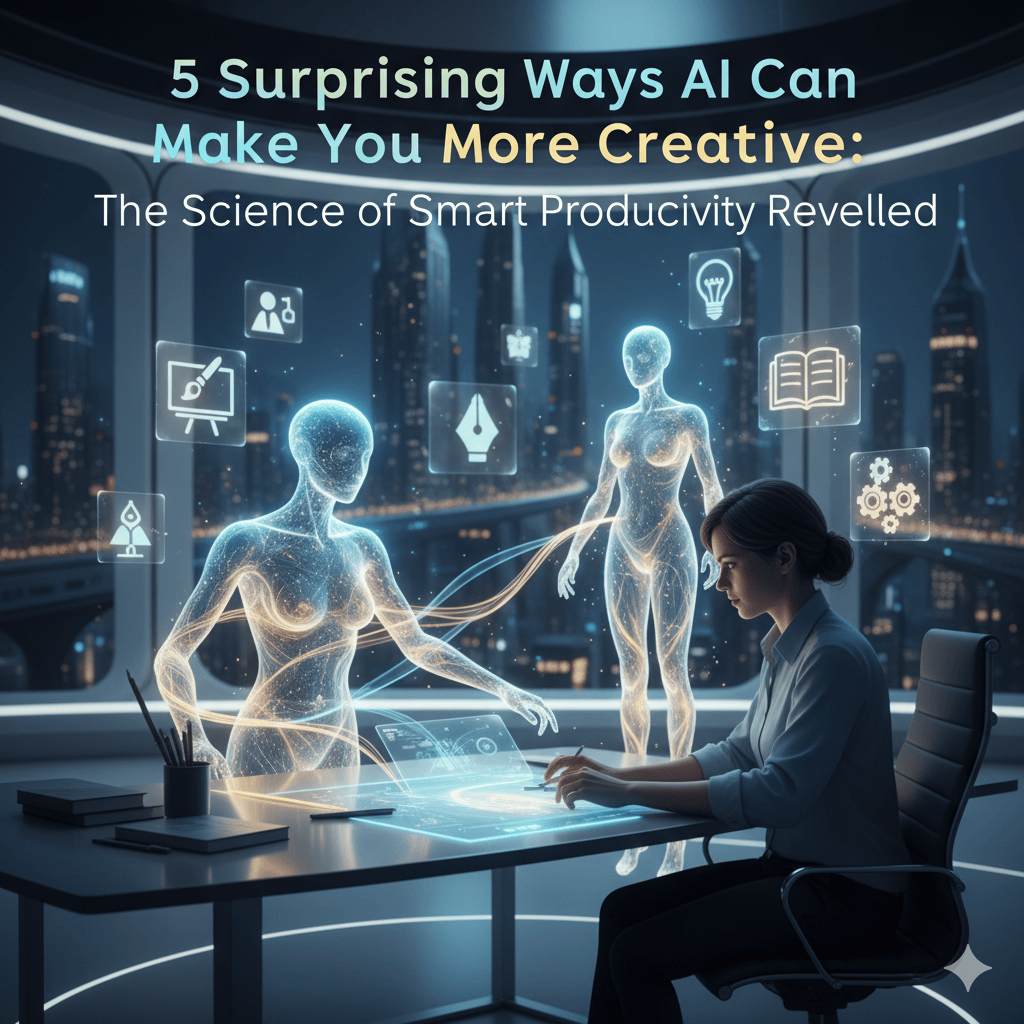
Is really 5 Surprising Ways Can AI Make You More Creative? Artificial intelligence is transforming the way we think about creativity. It’s not just about automation anymore. AI is becoming a partner in the creative process.
Can AI make you more creative? The answer is yes. AI can enhance creativity by offering new perspectives and ideas. It analyzes vast amounts of data to identify patterns and trends.
This capability allows AI to suggest innovative solutions. It can generate content that serves as a springboard for human creativity. AI-generated content is not about replacing human creativity but augmenting it.
The science of smart productivity is about working smarter, not harder. AI helps achieve this by automating repetitive tasks. This frees up time for more creative endeavors.
Digital tools for creativity, powered by AI, streamline workflows. They improve efficiency and allow for more focus on creative tasks. These tools are becoming essential in modern work environments.
Machine learning and creativity are closely linked. Machine learning algorithms provide suggestions that expand creative thinking. They offer alternatives that might not be immediately obvious to humans.
AI-assisted brainstorming is another area where AI shines. It helps generate a wider range of ideas and solutions. This leads to more diverse and innovative outcomes.
Collaborative creativity is enhanced by AI. It connects individuals and teams across different locations and disciplines. This fosters a more inclusive and diverse creative process.
Smart work techniques involve using AI to optimize time management. AI helps prioritize tasks effectively, ensuring that creative energy is used wisely. This balance between creativity and productivity is crucial.
Innovation and AI are driving new possibilities in various creative fields. AI helps identify creative trends and predict future innovations. This keeps creatives ahead of the curve.
The integration of AI in creative processes leads to more impactful results. It supports creative thinking techniques by providing new frameworks and methodologies. AI is not just a tool; it’s a creative partner.
Overview of AI in Creative Processes
AI is reshaping the creative landscape. It is no longer confined to routine tasks. Instead, AI is emerging as a collaborator in creativity.
The magic lies in how AI processes massive data sets. By analyzing data, AI finds patterns and generates insights. These insights spark new ideas and possibilities.
AI’s role extends to offering suggestions that might not occur to humans. Machine learning enhances creative processes by offering diverse alternatives. This expands the boundaries of traditional thinking.
Automated idea generation is another significant contribution of AI. With speed and accuracy, AI proposes novel concepts. This leads to faster and more efficient creative production.
AI-generated content can serve as a starting point for human projects. This content provides inspiration, igniting the creative journey. By offering fresh perspectives, AI stimulates innovative thought.
Digital tools for creativity, backed by AI, optimize workflow processes. These tools ensure that creative efforts are directed where they are most needed. The result is a streamlined approach to creative work.
In many fields, AI assists in bridging the gap between artistic and technical disciplines. Its analytical power can identify emerging trends. By doing so, it drives innovation and keeps creatives updated.
Key advantages of AI in creative processes include:
- Boosted Idea Generation: AI can quickly propose new concepts.
- Efficient Workflow Management: Tasks are automated, allowing more focus on creativity.
- Enhanced Collaboration: AI bridges disciplines, fostering interdisciplinary creativity.
AI also helps break down barriers in collaborative efforts. It connects teams who may be dispersed geographically. This allows for a more inclusive and diverse creative process.
Finally, AI’s use in creativity is about complementing human efforts. The focus is on augmenting, not replacing. Through a harmonious blend of human intuition and AI precision, new creative horizons are reached.
Innovation powered by AI offers new methodologies and frameworks. These support the exploration of uncharted creative territories. This ongoing evolution promises a future rich with novel artistic possibilities.
Importance of Creativity in Modern Work
Creativity is crucial in today’s dynamic work environment. It drives innovation, enabling unique solutions to emerge. As industries evolve, creative thinking becomes indispensable.
Modern challenges require adaptive and innovative approaches. Creativity fuels the ability to devise effective strategies. It allows companies to stay competitive and relevant.
In the knowledge economy, ideas are the main asset. Creativity unlocks the potential to innovate and grow. It transforms problems into opportunities with fresh perspectives.
Workers in all fields need creativity to excel. It enhances problem-solving and decision-making capabilities. Creative thinking enables workers to approach tasks with flexibility.
Organizations that prioritize creativity benefit immensely. They experience higher employee engagement and satisfaction. A culture of creativity fosters collective input and innovative outcomes.
The market demands original products and services. Companies that innovate capture new markets effectively. Creativity in product development leads to higher customer satisfaction.
Employers value creativity and seek it in employees. It is regarded as a top skill for modern workers. The ability to think creatively sets individuals apart.
Engaging with creative thinking techniques can:
- Boost Problem Solving: Creativity helps find multiple solutions.
- Enhance Collaboration: Teams achieve more with fresh ideas.
- Drive Market Success: Innovation leads to competitive products.
Employees who tap into their creativity are more fulfilled. They feel empowered to contribute and make a difference. Creativity in work leads to personal and professional growth.
For sustained growth, creativity should be nurtured continuously. This means creating environments where ideas can flourish. Encouragement and resources for creative exploration are crucial.
Work environments that stifle creativity risk stagnation. They may fall behind more innovative competitors. Creativity ensures that businesses remain agile and forward-thinking.
Fostering creativity is as important as technical skills. Both enable adaptability to the ever-changing workplace. Balancing analytical and creative skills is key for success.
Embracing creativity leads to enriched work experiences. It aligns with the demands of the modern workforce. Organizations that value creativity will lead in future innovation.
AI-generated content
AI-generated content is transforming the creative landscape. It offers new possibilities and fresh perspectives. With AI, the scope of creativity expands exponentially.
AI’s capability to process vast amounts of data is unparalleled. This power helps in crafting narratives and visuals. Patterns and trends that elude humans are easily spotted by AI.
The role of AI-generated content spans across industries. From writing to visual arts, AI contributes significantly. This influence aids in ideation and execution of creative concepts.
AI tools like GPT-3 are generating human-like text. These texts are coherent and contextually appropriate. Writers use AI for inspiration or content drafting.
Visual content creation also benefits from AI. Algorithms can design images based on specific themes. This enhances the creativity of designers, offering diverse options.
Music composition is another area where AI shines. It can produce harmonious tunes reflecting various styles. Artists collaborate with AI to explore new musical avenues.
AI-generated content is breaking traditional creative barriers. It provides starting points for new projects. Creatives use AI outputs to challenge their usual thinking patterns.
Key benefits of AI-generated content include:
- Idea Generation: Providing numerous concepts to explore.
- Efficiency: Reducing time spent on initial drafts.
- Innovation: Encouraging unconventional approaches and formats.
AI-generated content is not about replacing artists. Instead, it augments their abilities and tools. Human creativity remains at the core, complemented by AI’s strengths.
Ethical considerations are crucial in AI-generated content. Ensuring diverse and unbiased outputs is essential. Creators must use AI responsibly to maintain integrity.
How AI creates new ideas
AI systems generate ideas by analyzing data. They detect patterns and connections that inspire creativity. This analysis can reveal unseen possibilities for creators.
Machine learning algorithms enhance idea generation. They process inputs to suggest alternatives. The insights provided by AI can expand human creativity.
AI uses data from various fields to create new concepts. It combines information from literature, arts, and sciences. This fusion inspires innovations in unexpected ways.
AI-generated ideas emerge from three main processes:
- Pattern Recognition: Identifying trends and anomalies.
- Algorithm Design: Developing models that simulate creativity.
- Data Mining: Extracting valuable information from large datasets.
These processes help AI replicate aspects of human creativity. Algorithms can mimic human thought patterns. This results in innovative ideas that inspire further exploration.
Leveraging AI for idea creation requires collaboration. Creators must guide and refine AI suggestions. This synergy between human insight and machine analysis is powerful.
AI’s ability to generate new ideas enhances productivity. It offers diverse perspectives to tackle challenges. This leads to enriched creative processes and outcomes.
Examples of AI-generated works
AI has produced remarkable creative works across media. From poems to paintings, AI contributes in exciting ways. These examples illustrate the potential of AI in creativity.
The “Next Rembrandt” project created a painting using AI. Based on data from Rembrandt’s works, it produced an authentic piece. It demonstrates AI’s capacity to emulate artistic styles.
AI-written poetry offers another intriguing example. Algorithms generate verses that evoke emotion and thought. Such works mirror the creativity found in human poets.
In music, AI like AIVA composes original scores. These compositions are used in films, games, and advertisements. AI’s musical creations push the boundaries of traditional genres.
AI’s role in filmmaking is becoming prominent. Scripts are partially generated to inspire directors. This collaboration leads to unique storytelling and plot development.
The world of fashion also benefits from AI. Algorithms design clothing and accessories, reflecting current trends. This creativity-driven technology expands fashion innovation.
Notable AI-generated works span multiple domains:
- Art Projects: Using data to recreate historical styles.
- Literature and Poetry: Producing engaging narratives.
- Music Composition: Crafting harmonies with cultural impacts.
These examples illustrate AI’s versatility and creative power. By embracing AI, creators unlock new dimensions. The synergy between human intuition and AI logic heralds a creative revolution.
Creative thinking techniques
Creative thinking techniques can shape innovative solutions. By blending logical analysis with imaginative ideas, these techniques stimulate fresh perspectives. AI plays a pivotal role in enriching these methods.
AI-powered tools enhance traditional brainstorming. They generate diverse ideas swiftly. Leveraging AI widens the scope of creative exploration.
Visualization is a valuable creative technique. AI can transform text-based data into visual content. This approach makes complex information more digestible.
Problem-solving benefits significantly from AI involvement. AI suggests alternate pathways. It enables users to view challenges from new angles.
Mind mapping is a classic technique aided by AI. It organizes thoughts visually, revealing connections among ideas. AI applications simplify this process, making it interactive.
Lateral thinking involves considering unconventional solutions. AI, with its unique data analytics, supports lateral thinking efforts. It unveils hidden patterns, promoting innovative outcomes.
Some key creative thinking techniques enhanced by AI include:
- Brainstorming: Generating expansive ideas swiftly.
- Visualization: Converting concepts into visual formats.
- Problem-Solving: Offering alternate strategic insights.
Creativity and AI together foster a cycle of innovation. Each technique gains depth from AI’s analytical prowess. New technology trends push boundaries across creative domains.
AI-assisted brainstorming offers concrete advantages. It reduces mundane tasks, allowing creative focus. Additionally, automated systems provide continuous inspiration.
Adopting AI in creative processes doesn’t eclipse traditional methods. Instead, it expands their reach and scope. Creative thinking evolves, becoming more adaptive and versatile.
Integrating AI with traditional methods
Integrating AI with traditional methods enriches creative processes. It merges human insight with machine precision. The collaboration brings out the best in both worlds.
Traditional methods focus on problem-solving skills. AI enhances this by providing data-driven insights. Together, they create more robust solutions.
In fields like design, manual drafting coexists with AI modeling. This integration offers accuracy and creative flexibility. It results in more innovative design outcomes.
Writers can combine personal narratives with AI-assisted editing. AI enhances narrative quality by correcting inconsistencies. This partnership leads to more polished literary works.
By blending AI with traditional art techniques, artists gain new mediums. Digital tools expand the palette, offering endless possibilities. The fusion nurtures growth and broadens artistic horizons.
Key approaches to integrate AI with traditional methods include:
- Data Analysis: Using AI to support intuitive decision making.
- Design Automation: Merging manual craftsmanship with digital precision.
- Editorial Support: AI tools enhancing narrative coherence.
Integrating these methodologies requires thoughtful planning. Creatives must maintain control over their vision. AI serves to complement, not control, the creative process.
AI-assisted brainstorming
AI-assisted brainstorming revolutionizes idea generation. It overcomes cognitive limits by automating concept creation. This technique enriches group innovation sessions.
AI proposes ideas based on keyword inputs. It searches extensive datasets for similar ideas. This access broadens creative exploration.
Concept mapping is another facet where AI assists. Visualizing relationships and connections becomes simpler. Creators easily identify and enhance relevant ideas.
Interactive AI platforms support creative teams. They enable real-time idea sharing and development. This enhances collaboration across disciplines and distances.
Automated brainstorming offers specific advantages, including:
- Idea Diversity: Offering broad perspectives and options.
- Efficiency: Reducing time spent on ideation.
- Collaboration: Facilitating teamwork, irrespective of location.
AI eliminates typical brainstorming obstacles. It processes volumes of information quickly. This allows teams to focus on refining and implementing ideas.
The seamless blend of AI and brainstorming nurtures innovation. Creators can achieve more varied and sophisticated outputs. Embracing AI in brainstorming marks a significant step towards smart productivity.
Collaborative creativity
Collaborative creativity combines the strengths of various minds to produce innovative outcomes. AI plays a key role in enhancing this collaboration. It connects disparate ideas and individuals, encouraging seamless teamwork.
With AI, creative teams can transcend geographical limitations. Tools like shared virtual spaces facilitate collaboration. This interconnectedness fosters a more inclusive creative process.
AI analyzes and interprets data, offering insights that guide group decisions. It acts as a neutral facilitator, balancing diverse viewpoints. This removes biases that might skew creative judgments.
AI can manage and organize creative content efficiently. By cataloging and suggesting relevant information, AI helps teams focus on creativity rather than logistics. It simplifies the sharing of ideas and resources.
Automation of administrative tasks by AI frees up time for creative exploration. This shift in focus is crucial for maintaining momentum in creative projects. Teams can invest their efforts in refining and innovating.
Through AI, teams can tap into a broader range of creative resources. By analyzing global data trends, AI offers fresh perspectives. This widens the horizon for innovative solutions.
Technology enables the personalization of creative tools according to team preferences. AI customization adapts to the unique dynamics of each group, enhancing productivity. This tailored approach supports diverse creative needs.
Examples of AI-facilitated collaborative creativity include:
- Virtual Platforms: For seamless global collaboration.
- Content Management: Efficiently organizing creative resources.
- Data Analysis: Insights that guide strategic decisions.
AI supports interdisciplinary collaboration by bridging gaps between different fields. This synergy results in innovative breakthroughs that may not have emerged otherwise. Teams benefit from diverse expertise and perspectives.
Privacy and ethical use of AI in collaboration is essential. Ensuring data security and responsible AI practices is a shared responsibility. This fosters trust among creative teams.
Working with AI as a creative partner
Working with AI as a creative partner presents exciting new dynamics. AI provides a wealth of resources that enrich collaboration. By integrating with human teams, AI supports efficient and innovative outcomes.
AI aids in the ideation phase, suggesting various possibilities. It offers fresh insights based on vast datasets. This support sparks creativity, pushing boundaries beyond conventional limits.
Tasks like data analysis are best handled by AI. Automating such tasks gives creative teams more bandwidth. Their focus remains on creating and refining instead of sorting and sifting.
AI’s ability to predict trends is invaluable. It helps teams align their projects with market needs. This data-driven foresight optimizes creative efforts towards successful ventures.
Tips for effectively working with AI as a partner include:
- Trust in AI Tools: Rely on AI for mundane tasks.
- Leverage Data Insights: Use AI analysis for strategic direction.
- Maintain Creativity: Let AI enhance, not replace, human innovation.
AI adapts to team dynamics, adjusting to their specific needs. This personalization creates an ideal support environment. Teams retain their creative authority, with AI serving as an enabler.
Trust is fundamental for successful AI partnerships. Creators must remain open to AI-generated suggestions. Together, they form a synergy that enhances creative potential.
Case studies of successful collaborations
Real-world examples highlight successful collaborations between AI and humans. In the film industry, AI has assisted script development. By analyzing popular themes, it suggests story arcs that resonate with audiences.
In music, AI has been instrumental in composing original pieces. Artists use AI to explore new genres, resulting in unique compositions. The blend of AI and creativity fosters musical evolution.
Fashion designers leverage AI to predict trends. By analyzing customer preferences, AI helps in crafting innovative clothing lines. This collaboration optimizes creative design with consumer alignment.
AI’s role in advertising is becoming prominent. By analyzing consumer data, AI suggests campaigns. This ensures creative initiatives are strategically targeted for maximum impact.
Key takeaways from successful AI collaborations include:
- Script Development: Using AI for theme analysis.
- Musical Innovation: AI assisting in genre exploration.
- Fashion Trends: Predictive analytics for design optimization.
Several tech companies use AI for product design. Concepts like user interface benefit from AI insights. This enhances user experience through intuitive design elements.
These case studies emphasize the synergy between AI and human creativity. Each domain illustrates unique benefits of collaboration. AI supports rather than supersedes human effort, leading to enriched creative outputs.
Smart work techniques
Smart work techniques blend creativity and efficiency. AI plays a crucial role in streamlining workflows, enabling smarter work practices. This approach transforms how creative professionals function daily.
AI enhances time management by automating mundane tasks. This frees up valuable time for more important creative pursuits. Professionals can focus on innovation instead of routine tasks.
Prioritization is key to smart work. AI tools help by analyzing deadlines and work patterns. This data-driven approach optimizes workflow efficiency, ensuring tasks align with broader goals.
AI helps identify bottlenecks in creative processes. By analyzing project timelines, it suggests adjustments to improve productivity. These insights prevent delays and keep projects on track.
Communication is enhanced through AI in collaborative settings. Real-time feedback and suggestions help refine ideas quickly. This improves the quality and speed of creative outputs.
Smart work techniques include:
- Automation: Simplifies routine tasks.
- Prioritization Tools: Optimize workflow based on data.
- Real-time Feedback: Enhances communication and idea refinement.
AI assists in energy management by tracking work patterns. It suggests breaks and downtime to maximize output. These insights help maintain a healthy work-life balance.
AI-driven insights help set realistic goals. Understanding past performance data informs future goal-setting. This is vital for continuous improvement and achieving desired outcomes.
Adopting smart work techniques involves integrating AI thoughtfully. This ensures it enhances rather than disrupts current processes. It’s crucial to maintain a balance between technology and human intuition.
Digital tools for creativity
Digital tools, powered by AI, revolutionize creative processes. These tools enhance productivity while expanding creative capabilities. From design to writing, they provide versatile applications.
Graphic design software like Adobe’s suite benefits from AI. Features such as auto layouts and image enhancements improve efficiency. Designers can produce high-quality results faster.
Writing tools offer grammar corrections and content suggestions. AI analyzes writing patterns and offers structural improvements. This elevates writing quality, saving time on editing.
Music composition tools suggest melodies and harmonies. AI-driven algorithms analyze musical trends. This helps musicians explore new styles and refine their compositions.
Examples of digital tools for creativity include:
- Graphic Design Software: AI-enhanced design capabilities.
- Writing Assistants: Content and grammar improvements.
- Music Composers: Melodic and harmonic suggestions.
AI-powered video editing software simplifies post-production. Features like automatic scene detection accelerate editing tasks. This allows creators to focus on storytelling.
Digital tools not only enhance creativity but democratize it. They make high-level creative resources accessible to a broader audience. More people can now participate in creative fields with these tools.
Creative productivity tools
Creative productivity tools, strengthened by AI, streamline project management. These tools organize tasks, track progress, and facilitate communication. Their role is to simplify complex processes.
Project management software benefits from AI for timeline estimations. Predictive analytics forewarns teams about potential delays. This allows for proactive adjustments to maintain project timelines.
Time-tracking applications use AI to assess productivity patterns. They suggest optimal working times for peak output. This personalized approach maximizes creative efficiency.
Communication platforms enhance team interaction. AI-driven summaries keep teams updated on project statuses. This ensures everyone is on the same page without lengthy meetings.
Core features of creative productivity tools include:
- Timeline Estimation: Predictive insights for scheduling.
- Time Tracking: Identifies peak productivity.
- Communication Tools: Facilitate seamless updates.
In creative fields, version control is vital. AI-powered tools manage file versions, ensuring data integrity. This eliminates confusion and loss of work during collaborations.
Resource management tools optimize allocation based on project needs. AI analyzes resource distribution, suggesting improvements. This keeps creative teams well-equipped for any demands.
Ultimately, creative productivity tools are indispensable in modern workflows. They enhance efficiency, enabling creative teams to focus more on innovation and less on logistics. Their integration signifies smart work at its best.
Conclusion
AI is redefining creativity across industries. It’s clear that AI offers significant enhancements to creative processes. From idea generation to project management, AI complements human ingenuity.
AI enables innovative approaches to traditional challenges. It assists in overcoming creative blocks by offering fresh perspectives. These capabilities foster a new era of creativity.
By combining AI with human skills, we see unprecedented growth in creative outputs. The synergy between tech and creativity is transformative. Balancing technology use with artistic intuition is key.
As AI tools become more accessible, creativity becomes more democratic. Individuals from diverse backgrounds can contribute unique ideas. This inclusivity broadens the scope of creative possibilities.
Key AI contributions to creativity include:
- Enhanced Idea Generation: Offers fresh perspectives.
- Project Management Tools: Streamline processes.
- Democratized Creativity: Broadens participation.
Incorporating AI requires thoughtful integration. The goal is to enhance, not overshadow, human creativity. By understanding AI’s capabilities, creatives can leverage technology effectively.
Future of innovation and AI
The future holds immense potential for AI in creativity. Ongoing research and development continue to expand AI’s capabilities. Innovations are likely to reshape how we approach creative challenges.
Emerging technologies, such as machine learning, will further refine creativity. They are expected to introduce even smarter tools. This will enhance efficiency and creative outputs.
Significant future trends to watch include:
- Integration with Emerging Technologies: Expanding AI’s role.
- Advanced Machine Learning Applications: Enhancing creative tools.
- Evolution of AI-driven Creativity: Transforming creative landscapes.
Future innovations promise to cultivate creativity. By leveraging AI, we can unlock new realms of human imagination. These advancements highlight the harmonious potential of AI and creativity.
Final thoughts on AI and creativity
AI is a powerful ally in creative endeavors. It augments human ability, offering new avenues for expression. By embracing AI, we broaden our creative potential.
Our world benefits from a synergy between AI and creativity. This partnership fosters innovation, solving complex problems. It’s vital to pursue responsible use of AI in creativity.
As we navigate this evolving landscape, we must remain open to change. The future of creativity lies in collaboration with technology. Together, humans and AI can achieve remarkable feats.
Your point of view caught my eye and was very interesting. Thanks. I have a question for you. https://accounts.binance.info/es/register?ref=RQUR4BEO
Can you be more specific about the content of your article? After reading it, I still have some doubts. Hope you can help me.
I don’t think the title of your article matches the content lol. Just kidding, mainly because I had some doubts after reading the article. https://www.binance.com/register?ref=IHJUI7TF
Can you be more specific about the content of your article? After reading it, I still have some doubts. Hope you can help me. https://accounts.binance.info/en-ZA/register?ref=B4EPR6J0
Thanks for sharing. I read many of your blog posts, cool, your blog is very good.
Thank you for your sharing. I am worried that I lack creative ideas. It is your article that makes me full of hope. Thank you. But, I have a question, can you help me? https://www.binance.com/id/register?ref=UM6SMJM3
Thanks for sharing. I read many of your blog posts, cool, your blog is very good.
I don’t think the title of your article matches the content lol. Just kidding, mainly because I had some doubts after reading the article.
Can you be more specific about the content of your article? After reading it, I still have some doubts. Hope you can help me.
I don’t think the title of your article matches the content lol. Just kidding, mainly because I had some doubts after reading the article.
Your point of view caught my eye and was very interesting. Thanks. I have a question for you.
Your point of view caught my eye and was very interesting. Thanks. I have a question for you.
Can you be more specific about the content of your article? After reading it, I still have some doubts. Hope you can help me.
Your point of view caught my eye and was very interesting. Thanks. I have a question for you.
Your point of view caught my eye and was very interesting. Thanks. I have a question for you.
Thank you for your sharing. I am worried that I lack creative ideas. It is your article that makes me full of hope. Thank you. But, I have a question, can you help me?
Can you be more specific about the content of your article? After reading it, I still have some doubts. Hope you can help me.
Thanks for sharing. I read many of your blog posts, cool, your blog is very good. https://accounts.binance.info/ES_la/register-person?ref=VDVEQ78S
Thanks for sharing. I read many of your blog posts, cool, your blog is very good.
I don’t think the title of your article matches the content lol. Just kidding, mainly because I had some doubts after reading the article.
Thank you for your sharing. I am worried that I lack creative ideas. It is your article that makes me full of hope. Thank you. But, I have a question, can you help me?
I don’t think the title of your article matches the content lol. Just kidding, mainly because I had some doubts after reading the article.
Thank you for your sharing. I am worried that I lack creative ideas. It is your article that makes me full of hope. Thank you. But, I have a question, can you help me?
Your point of view caught my eye and was very interesting. Thanks. I have a question for you. https://accounts.binance.info/register/person?ref=IHJUI7TF
Can you be more specific about the content of your article? After reading it, I still have some doubts. Hope you can help me.
Thank you for your sharing. I am worried that I lack creative ideas. It is your article that makes me full of hope. Thank you. But, I have a question, can you help me?
Thank you for your sharing. I am worried that I lack creative ideas. It is your article that makes me full of hope. Thank you. But, I have a question, can you help me?
Your article helped me a lot, is there any more related content? Thanks! https://accounts.binance.bh/register/person?ref=JW3W4Y3A
Your point of view caught my eye and was very interesting. Thanks. I have a question for you.
I don’t think the title of your article matches the content lol. Just kidding, mainly because I had some doubts after reading the article.
Your point of view caught my eye and was very interesting. Thanks. I have a question for you.
Your article helped me a lot, is there any more related content? Thanks!
I don’t think the title of your article matches the content lol. Just kidding, mainly because I had some doubts after reading the article.
Your article helped me a lot, is there any more related content? Thanks!
Thank you for your sharing. I am worried that I lack creative ideas. It is your article that makes me full of hope. Thank you. But, I have a question, can you help me?
Thanks for sharing. I read many of your blog posts, cool, your blog is very good.
Thanks for sharing. I read many of your blog posts, cool, your blog is very good. https://www.binance.com/register?ref=IXBIAFVY
Your article helped me a lot, is there any more related content? Thanks! https://www.binance.com/register?ref=W49FLGDN
Thank you for your sharing. I am worried that I lack creative ideas. It is your article that makes me full of hope. Thank you. But, I have a question, can you help me?
Your point of view caught my eye and was very interesting. Thanks. I have a question for you. https://www.binance.com/register?ref=IHJUI7TF
Your article helped me a lot, is there any more related content? Thanks! https://accounts.binance.bh/en-TR/register-person?ref=MST5ZREF
I don’t think the title of your article matches the content lol. Just kidding, mainly because I had some doubts after reading the article.
Thanks for sharing. I read many of your blog posts, cool, your blog is very good.
Your article helped me a lot, is there any more related content? Thanks! https://www.binance.com/register?ref=MBLCVVZG
Alright, 78win8 has got some interesting slots I haven’t seen anywhere else. Def worth browsing to see whats new! Check them out at 78win8.
88jilli been pretty generous to me lately. Bonus codes all the time and my favorite games are there. Worth a look you wont regret it, 88jilli.
Yo, trying out bbjl77 tonight! Saw a friend streaming it, looks solid. Hope to get some wins. Head on over to bbjl77.
I don’t think the title of your article matches the content lol. Just kidding, mainly because I had some doubts after reading the article. https://www.binance.bh/register?ref=IXBIAFVY
Thank you for your sharing. I am worried that I lack creative ideas. It is your article that makes me full of hope. Thank you. But, I have a question, can you help me? https://www.binance.com/futures/ref?code=IHJUI7TF
Your point of view caught my eye and was very interesting. Thanks. I have a question for you. https://www.binance.bh/register?ref=JW3W4Y3A
Can you be more specific about the content of your article? After reading it, I still have some doubts. Hope you can help me.
Your article helped me a lot, is there any more related content? Thanks!
Thank you for your sharing. I am worried that I lack creative ideas. It is your article that makes me full of hope. Thank you. But, I have a question, can you help me?
Your article helped me a lot, is there any more related content? Thanks! https://accounts.binance.bh/register/person?ref=JW3W4Y3A
I don’t think the title of your article matches the content lol. Just kidding, mainly because I had some doubts after reading the article.
Your article helped me a lot, is there any more related content? Thanks! https://www.binance.com/register?ref=QCGZMHR6
Thank you for your sharing. I am worried that I lack creative ideas. It is your article that makes me full of hope. Thank you. But, I have a question, can you help me? https://www.binance.bh/register?ref=W49FLGDN
The slot variety is insane! I spent hours trying different games and they all look stunning. Big wins are actually possible at jilicashslot
I really enjoy the variety of slots available here. The jackpots feel reachable and the vibe is just right. Big shoutout to ph16jili!
Thank you for your sharing. I am worried that I lack creative ideas. It is your article that makes me full of hope. Thank you. But, I have a question, can you help me? https://www.binance.bh/futures/ref?code=IHJUI7TF
I don’t think the title of your article matches the content lol. Just kidding, mainly because I had some doubts after reading the article.