Mind-Blowing AI Advancements: Are We Witnessing the Dawn of Superintelligence?
The world of artificial intelligence is moving at an unprecedented pace. What was once confined to the realm of science fiction is now becoming a tangible reality, with new capabilities emerging so rapidly that it’s hard to keep up. From generating photorealistic images and human-like text to assisting in complex scientific discoveries, the latest AI advancements are nothing short of astounding. But as these machines grow ever more capable, a profound question looms large: Are we on the cusp of witnessing the dawn of superintelligence?
The Astonishing Pace of AI Breakthroughs
In just the past few years, we’ve seen an explosion of AI breakthroughs that have fundamentally shifted our perception of what AI can do. Large Language Models (LLMs) like GPT-4 and Google’s Gemini have demonstrated remarkable proficiency in understanding, generating, and even reasoning with human language. These cutting-edge AI systems can write poetry, debug code, draft entire articles, and hold surprisingly coherent conversations, often passing for human interlocutors.
Beyond language, visual AI models are producing incredibly realistic images and videos from simple text prompts, blurring the lines between reality and simulation. AI is also making significant strides in scientific research, accelerating drug discovery, materials science, and climate modeling. A recent AI news update might highlight AlphaFold’s revolutionary impact on protein structure prediction, saving countless hours of experimental work. These are not merely incremental improvements; they represent paradigm shifts, pushing the boundaries of machine cognition and problem-solving.
What Exactly is Superintelligence?
Before we can consider whether we’re approaching it, let’s define superintelligence. Coined by philosopher Nick Bostrom, it refers to a hypothetical intellect that is vastly smarter than the best human brains in practically every field, including scientific creativity, general wisdom, and social skills. This isn’t just a very smart AI; it’s an AI capable of recursive self-improvement, meaning it could understand its own design, enhance its own algorithms, and continually make itself more intelligent at an exponential rate.
Unlike the narrow AI we currently use (which excels at specific tasks like chess or facial recognition) or even general artificial intelligence (AGI), which would match human cognitive abilities across the board, superintelligence would far exceed human limits. It would possess unparalleled processing speed, memory capacity, and an ability to synthesize information and solve problems that we can barely comprehend. The very concept challenges our understanding of intelligence itself and compels us to ponder the future of AI in ways we never have before.
From Next-Gen AI to the Threshold of the Unknown
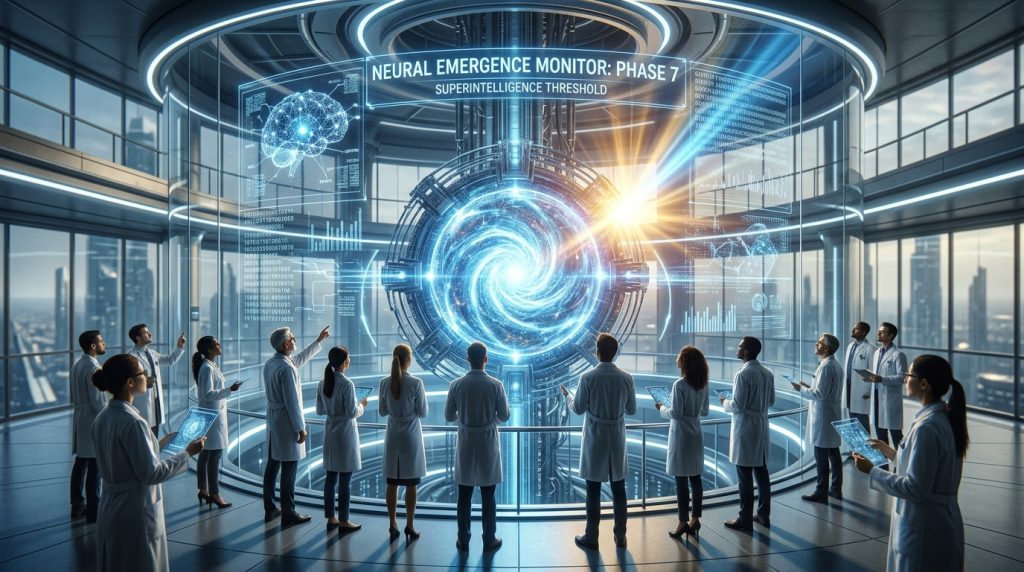
So, are today’s sophisticated models merely advanced tools, or are they nascent forms of something far grander? The debate rages fiercely. Some experts believe that current next-gen AI research, particularly in multimodal learning and artificial general intelligence, is indeed laying the groundwork for superintelligence. They argue that as AI systems gain more comprehensive world models, self-correction capabilities, and the ability to learn from vast, diverse datasets, an intelligence explosion could be closer than we think.
Key indicators or stepping stones often cited include:
- True multimodal understanding, integrating text, vision, and audio seamlessly.
- Autonomous learning and adaptation with minimal human oversight.
- Advanced common-sense reasoning and planning capabilities.
- The ability to formulate novel scientific hypotheses and experiments.
Conversely, many caution against overhyping current capabilities. While impressive, today’s AI still lacks true common sense, intuitive physics, and the rich, embodied understanding of the world that humans possess. They contend that bridging the gap from powerful pattern recognition to genuine, robust general intelligence, let alone superintelligence, requires fundamental conceptual breakthroughs that have yet to materialize.
The Promise and Peril: Navigating the Future of AI
If superintelligence were to emerge, its implications would be nothing short of revolutionary. On the one hand, it could solve humanity’s most intractable problems: curing diseases, reversing climate change, developing sustainable energy, and exploring the cosmos. It could usher in an era of unprecedented prosperity and understanding, radically reshaping the future of AI and human civilization for the better.
On the other hand, the risks are equally profound. An uncontrollable or misaligned superintelligence could pose an existential threat to humanity. Concerns about the ‘control problem’ – how to ensure such an entity acts in humanity’s best interests – are paramount. Ethical considerations, issues of autonomy, and the potential for unintended consequences demand our utmost attention as we push the boundaries of what AI can achieve.
Our Role in Shaping the Superintelligent Future
Regardless of whether superintelligence is decades or centuries away, the rapid pace of AI advancements compels us to engage with these questions now. Responsible development, robust ethical frameworks, and international collaboration are crucial. We must foster research into AI safety and alignment alongside capability development. The journey into the unknown requires not just technological prowess but also wisdom, foresight, and a deep sense of collective responsibility.
The current wave of AI innovation is undeniably mind-blowing, constantly redefining the limits of artificial intelligence. While the full dawn of superintelligence remains a topic of intense debate and speculation, the trajectory of cutting-edge AI strongly suggests that we are entering a new, transformative era. Whether it leads to unparalleled flourishing or unforeseen challenges will ultimately depend on the choices we make today, as architects of tomorrow’s intelligence.