
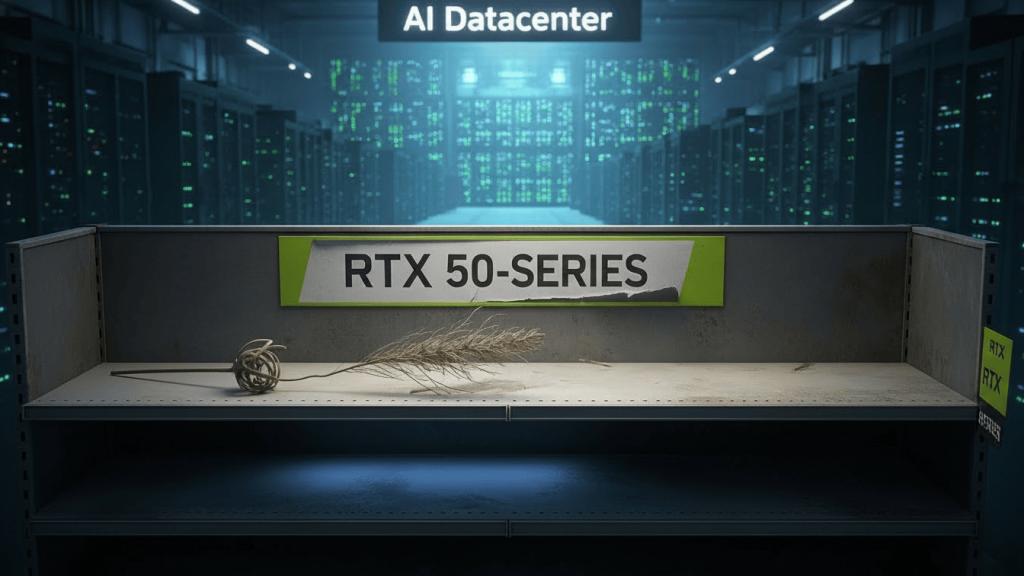
If you have been anxiously saving up for a next-gen PC upgrade, the latest rumors about massive Nvidia GPU supply cuts might just ruin your plans. According to alarming new reports, the “AI Gold Rush” is finally coming for the last stronghold of the consumer PC market: reasonable availability.
It looks like we are heading for a sequel to the Great GPU Shortage of 2020, but this time, crypto miners aren’t the villains.
A new report from Overclock3D suggests that Nvidia is planning to slash consumer graphics card volumes significantly in early 2026. If these Nvidia GPU supply cuts materialize, we are looking at sky-high prices, empty shelves, and a market where “MSRP” is nothing more than a nostalgic concept.
In this deep dive, we will analyze the credibility of these rumors, explain why your VRAM is being sacrificed for chatbots, and discuss what you need to do to prepare for the shortage.

The Rumor: Massive Nvidia GPU Supply Cuts Incoming
The report, which originated from board partner channels in China and was amplified by Overclock3D, paints a grim picture for the launch window of the RTX 50-series.
The leak suggests that Team Green plans to reduce the supply of its consumer GeForce GPUs by a staggering 30% to 50% in the first quarter of 2026. This isn’t a minor adjustment; it is a market-defining contraction.

Which Cards Are on the Chopping Block?
Crucially, these Nvidia GPU supply cuts are not affecting all cards equally. They appear to be targeting the “sweet spot” GPUs—the models that most gamers actually buy. The report indicates that the RTX 5060 Ti (specifically the 16GB variant) and the RTX 5070 Ti will see the steepest declines in production.
This is a strategic nightmare for consumers because these cards usually offer the best price-to-performance ratio. By throttling these specific models, Nvidia forces users into a difficult dilemma:
- Settle for Less: Buy a weaker RTX 5060 with limited VRAM.
- Pay the Premium: Upsell yourself to an insanely expensive RTX 5080 or 5090.
Why Are We Seeing These Nvidia GPU Supply Cuts?
Why would a company effectively stop selling its most popular product? The answer lies in the components. Specifically, the high-speed memory modules (GDDR7 and HBM).
The primary driver behind the Nvidia GPU supply cuts is the explosive demand for Artificial Intelligence.
The “AI Tax” on Your VRAM
Modern AI accelerators—the massive chips used by OpenAI, Google, and Meta to train models like GPT-5—require an immense amount of high-speed memory. Nvidia’s enterprise chips (like the Blackwell B200) use the same supply chain resources as your gaming GPU.
Nvidia faces a simple economic choice:
- Option A: Use a memory module to build an RTX 5070 and sell it to a gamer for $700.
- Option B: Use that same manufacturing capacity to build an AI accelerator and sell it to a tech giant for $30,000.
From a business perspective, the Nvidia GPU supply cuts make perfect sense. From a consumer perspective, it is a disaster. The memory chips that should be rendering ray-traced reflections in Grand Theft Auto VI are instead sitting in a server rack, generating email summaries.

How Nvidia GPU Supply Cuts Will Affect Pricing
We have seen this movie before. When supply drops and demand remains constant (or rises), prices skyrocket.
If the Nvidia GPU supply cuts hit as hard as predicted, the “official” launch prices for the RTX 50-series will be meaningless. Retailers will likely mark up remaining stock immediately.
The Return of Scalpers
During the 2020 shortage, scalpers used bots to buy up every available card. With supply restricted by up to 50%, scalpers will almost certainly return. If you aren’t refreshing the store page within seconds of a restock, you will be buying your GPU on eBay for double the price.
The Used Market Inflation
These Nvidia GPU supply cuts will also ripple into the used market. Currently, you can find decent deals on used RTX 3080s or 4070s. However, once the new cards become unobtainable, gamers will flock back to older generations. Expect the value of your current GPU to hold steady or even increase in 2026.
Nvidia GPU Supply Cuts vs. The Crypto Boom
Veterans of the PC Master Race will remember the dark days of 2020-2021, where Ethereum miners bought pallets of GPUs. Is this the same thing?
Not exactly. The crypto boom was demand-side (everyone wanted cards). This 2026 crisis is supply-side (Nvidia is refusing to make enough cards).
The result, however, is the same: You can’t play games. The difference is that while the crypto crash eventually flooded the market with cheap used mining cards, these AI chips will never be resold to gamers. They will live in data centers until they die. This means there will be no “post-crash flood” of cheap GPUs.
What About AMD and Intel?
With Nvidia GPU supply cuts looming, this should be the perfect opportunity for competitors to swoop in, right?
- AMD (Radeon): Rumors suggest AMD is exiting the high-end market for its next generation (RDNA 4), focusing only on mid-range value. If they can produce enough stock, they might win big. However, they rely on the same TSMC manufacturing nodes as Nvidia, meaning they might face similar supply constraints.
- Intel (Arc): Intel is still struggling to gain a foothold. While Battlemage looks promising, it is unlikely to be a true alternative for high-end enthusiasts.
Survival Guide: Preparing for the Shortage
If the rumors of Nvidia GPU supply cuts are true, you need a game plan for 2026.
- Buy Now, Don’t Wait: If you see a good deal on an RTX 40-series card today, grab it. Waiting for the RTX 50-series “price drop” is a gamble you will likely lose.
- Take Care of Your Current Card: Clean the dust filters, repaste the thermal compound, and undervolt your GPU. You might need it to last a few more years than expected.
- Lower Your Expectations: You might not be playing at 4K Ultra in 2026. Be prepared to embrace DLSS Performance Mode and lower texture settings.
Conclusion
The era of easy upgrades is over. The Nvidia GPU supply cuts signal a permanent shift in the hardware industry where gamers are no longer the VIP customers. We are now second-class citizens to the AI revolution.
While we hope these reports are exaggerated, the economic incentives for Nvidia are too strong to ignore. The AI money train is leaving the station, and it’s taking our graphics cards with it.
Are you worried about the rumored Nvidia GPU supply cuts? Will you switch to AMD if Team Green abandons gamers?