
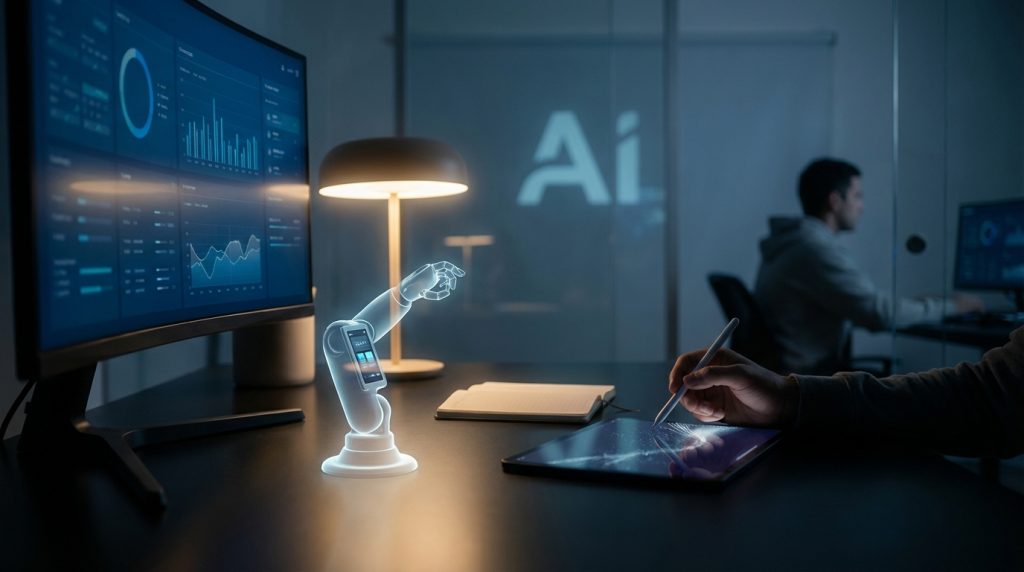
ChatGPT vs. Human Creativity: Navigating AI Job Displacement and the Future of Creative Work
The digital world is abuzz, and at the heart of the conversation is ChatGPT. This powerful generative AI model has captivated imaginations and sparked widespread debate. For creatives across industries – writers, designers, marketers, artists – the question isn’t just academic; it’s deeply personal: Is AI coming for your job, or merely changing it? The rapid advancements in AI have undeniable implications for the future of creative jobs, forcing us to re-evaluate what it means to be a human creative in the 21st century.
The Meteoric Rise of Generative AI: Understanding ChatGPT’s Impact
Generative AI tools like ChatGPT have moved from niche tech to mainstream marvel in what feels like an instant. These systems can generate human-like text, images, and even code based on prompts, performing tasks that were once exclusively within the domain of human intellect and skill. For content creation, ChatGPT can draft articles, brainstorm ideas, write marketing copy, summarize complex information, and even produce creative fiction. This unprecedented capability has led to a significant ChatGPT impact across various sectors, particularly those reliant on text-based output.
The speed and efficiency with which AI can produce content are staggering. A human writer might take hours to research and draft a blog post; ChatGPT can provide a decent first draft in minutes. This raw output potential naturally fuels fears of AI job displacement. If an AI can do it faster and cheaper, what’s left for us?
The Fear Factor: Is AI Really Coming for Creative Jobs?
The concern is legitimate. Certain repetitive or formulaic creative tasks are undeniably vulnerable to automation. Think about:
- Basic Content Generation: Producing SEO-optimized blog posts on common topics, social media updates, or product descriptions.
- Data Summarization: Quickly extracting key points from lengthy reports or transcripts.
- First Drafts: Overcoming writer’s block by generating initial outlines or rough text.
- Ideation Support: Brainstorming countless headlines, taglines, or campaign concepts.
In these areas, the ChatGPT impact is already being felt, streamlining workflows and potentially reducing the demand for purely entry-level creative roles focused on high-volume, low-complexity tasks. This is where the narrative of AI job displacement often takes root.
The Indispensable Edge: What Defines Human Creativity?
While AI can mimic creativity, it doesn’t possess it in the human sense. True AI creativity is still a misnomer; it’s pattern recognition and recombination. Here’s what sets human creatives apart:
- Emotional Intelligence & Empathy: Understanding nuanced human emotions, cultural contexts, and audience desires – and crafting messages that resonate deeply.
- Strategic Vision & Critical Thinking: Developing original concepts, long-term strategies, and truly innovative solutions that go beyond existing data.
- Ethical Judgment & Responsibility: Navigating complex ethical dilemmas, ensuring accuracy, and taking accountability for creative output.
- Unique Life Experiences: Injecting personal voice, perspective, and genuine human insight that AI simply cannot replicate.
- Conceptualization & Originality: Creating something truly novel, pushing boundaries, and challenging conventions, rather than remixing existing data.
These are the hallmarks of authentic human input that drive genuine connection and breakthrough innovation. The future of creative jobs depends on leveraging these uniquely human strengths.
The Power of Human-AI Collaboration: A New Synergy
Instead of viewing AI as a competitor, smart creatives are embracing it as a powerful co-pilot. The future isn’t about AI *replacing* humans, but about human-AI collaboration enhancing human capabilities. Imagine:
- AI as a Research Assistant: Quickly compiling information and generating initial summaries, freeing up human time for analysis and strategic thought.
- AI as a Brainstorming Partner: Providing endless variations of ideas, allowing humans to select, refine, and infuse them with their unique perspective.
- AI as an Efficiency Tool: Automating mundane tasks like proofreading, formatting, or creating multiple versions for A/B testing, letting creatives focus on high-value work.
- AI for Personalization at Scale: Generating tailored content snippets based on user data, which a human can then review and deploy strategically.
This paradigm shift transforms creative roles. The emphasis moves from mere production to curation, strategic direction, and injecting the ‘human touch’ that makes content truly compelling. New AI jobs are even emerging, such as ‘prompt engineers’ who specialize in communicating effectively with AI models.
Adapting and Thriving: New Skills for the AI-Powered Creative
The landscape of AI jobs is evolving, and creatives who adapt will thrive. Key skills for the future include:
- Prompt Engineering: The ability to craft precise and effective prompts to get the best output from AI tools.
- Critical Evaluation: Knowing how to assess AI-generated content for accuracy, bias, and quality, and refine it.
- Strategic Integration: Understanding where and how to best integrate AI into creative workflows to maximize impact.
- Human-Centric Design: Focusing on the uniquely human elements of storytelling, emotion, and connection that AI cannot replicate.
- Continuous Learning: Staying abreast of AI advancements and new tools to leverage their potential effectively.
The future of creative jobs is not one of obsolescence, but of evolution. Professionals who embrace AI as a tool for augmentation, rather than fearing it as a threat, will find themselves at the forefront of innovation.
Conclusion: A Future of Augmented Creativity
The debate around ChatGPT impact and its role in creative professions will undoubtedly continue. While the specter of AI job displacement is real for some tasks, the broader picture points towards a profound transformation rather than outright elimination. For human creatives, this is an invitation to elevate their craft, focus on their unique strengths, and master the art of human-AI collaboration. By embracing generative AI as an assistant and accelerator, we can unlock unprecedented levels of efficiency and explore new frontiers of AI creativity, ensuring a vibrant and exciting future for creative work.