
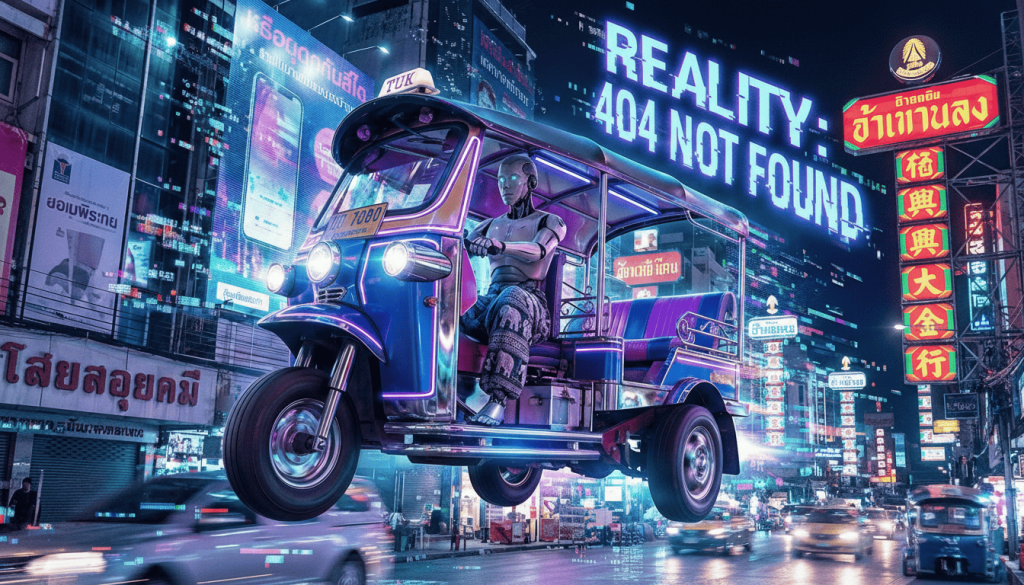
For the last two years, we have been hearing about the “video revolution” in AI. We watched the grainy demos. We saw the Will Smith eating spaghetti monstrosities. Then, we saw the polished, terrifyingly real teasers from OpenAI’s Sora. We were told it was coming. We were told it would change everything.
However, most of us assumed the revolution would start in San Francisco, or maybe London, or perhaps inside a secret bunker in New York.
We were wrong.
In a move that has left Silicon Valley scratching its collective hoodie, the official Sora launch in Thailand has just happened. Surprisingly, the Land of Smiles has become the Land of Simulated Reality. If you are currently reading this from a beach in Phuket or a coworking space in Chiang Mai, congratulations: You are the world’s beta testers for the death of “seeing is believing.”
Consequently, while the rest of the world waits in a digital queue, Thailand has been granted full mobile access to the most powerful video generation model in human history. Naturally, this raises a few questions. Why Thailand? What happens when you give 70 million people the power to generate hyper-realistic fake news on their iPhones? And most importantly, how long until a tourist books a hotel that was hallucinated by an AI?
In this exhaustive deep dive, we are going to unpack the Sora launch in Thailand, analyze the terrifying and hilarious implications of this rollout, and explain why Southeast Asia is fast becoming the global laboratory for our cyberpunk future.
Part 1: The “Why” – Why Did the Robots Pick Bangkok?
To the casual observer, the Sora launch in Thailand might seem random. After all, Thailand is usually associated with pristine beaches, incredible street food, and traffic jams that defy the laws of physics—not necessarily bleeding-edge AI deployment.
However, if you have been paying attention to the digital landscape of Southeast Asia, this makes perfect sense. In fact, it is a stroke of genius by OpenAI.
The Social Media Capital of the World
First of all, Thailand is arguably the most “online” country on Earth. Bangkok consistently ranks as one of the cities with the highest number of Facebook users per capita. The adoption rate of TikTok, Instagram, and Line is staggering. Furthermore, the Thai creative economy is built almost entirely on short-form video.
Therefore, OpenAI isn’t looking for software engineers to test their code; rather, they are looking for “vibe curators” to break their model. They need a population that lives and breathes video content to push Sora to its absolute limits. By prioritizing the Sora launch in Thailand, they are handing the tool to a user base that is sophisticated, hungry for engagement, and incredibly quick to adopt new trends.
The “Sabai Sabai” Regulatory Environment
Moreover, we cannot ignore the elephant in the room: Regulation.
In the European Union, the AI Act is looming like a dark cloud over every tech launch. Similarly, in the United States, lawsuits from artists and studios are piling up faster than unresolved Jira tickets. In contrast, Asia represents a more flexible—or perhaps “experimental”—frontier.
The Sora launch in Thailand allows OpenAI to test the waters in a market that is enthusiastic about tech but currently has less aggressive regulatory friction than Brussels or Washington. Consequently, it is a sandbox. If Sora accidentally generates a video that causes a minor societal panic, it is a “learning experience” in a regional market rather than a congressional hearing in D.C.
Ultimately, Thailand offers the perfect mix: high digital literacy, a massive creator economy, and a regulatory environment that (for now) is saying, “Let’s see what happens.”
Part 2: The Pocket Reality Machine
So, what exactly did Thai users get? This isn’t just a web interface where you type a prompt and wait ten minutes. The Sora launch in Thailand is mobile-first.
Specifically, the app allows users to generate 1080p, hyper-realistic video clips directly on their phones. Additionally, it features a new mode called “Cameos,” which was rumored for months but has finally debuted here.
The “Cameo” Feature: Narcissism 2.0
The “Cameo” feature is where things get truly wild. Basically, it allows you to upload a selfie, and Sora will insert “you” (or a statistically probable version of you) into the generated video.
For instance, you can type: “Me riding a dragon over the Chao Phraya River at sunset, cyberpunk style.” Previously, you needed a green screen, a VFX team, and a budget of $50,000 to do that. Now, thanks to the Sora launch in Thailand, you can do it while waiting for your Pad Thai.
However, this convenience comes with a creepy undertone. The AI isn’t just pasting your face on a body; instead, it is re-rendering your likeness into the lighting and physics of the scene. It owns your face data. Consequently, the line between “cool Instagram story” and “identity theft kit” just got extremely blurry.
The “Vibe” Engine
Furthermore, the app seems designed specifically for the “vibe coding” generation we discussed in previous articles. You don’t need to know camera angles or lighting terminology. You just describe a “vibe.”
- “Sad rainy mood in a neon 7-Eleven.”
- “High-energy Muay Thai fight but they are dancing disco.”
The Sora launch in Thailand proves that the future of creativity isn’t about skill; rather, it is about taste. The barrier to entry for high-end video production has effectively dropped to zero. As a result, every teenager with a smartphone in Bangkok is now a potential Hollywood director—or a potential disinformation agent.
Part 3: The Death of “Pics or It Didn’t Happen”
We have a saying on the internet: “Pics or it didn’t happen.” It was the gold standard of proof. If you had a video, it was real.
Unfortunately, the Sora launch in Thailand has officially killed that saying. We need a funeral for it.
Consider this scenario: A video surfaces on Twitter (or X, or whatever Elon calls it this week) showing a politician accepting a bribe in a dim alleyway. The lighting looks perfect. The shadows match. The lip-sync is flawless.
In the past, we would analyze the pixels. Now, with the Sora launch in Thailand, that video could have been generated by a 15-year-old on a bus ride to school.
The Tourism Trap
Moreover, let’s look at a lower-stakes but equally annoying problem: Tourism. Thailand’s economy relies heavily on tourism. Traditionally, hotels use Photoshop to make their pools look bigger. That’s a “white lie.”
However, with Sora, a scammer can generate a video walk-through of a luxury resort that does not exist. They can show you the view from the balcony, the steam rising off the food, and the waves hitting the private beach. You book it, you pay the deposit, and you show up to an empty lot in Pattaya.
The Sora launch in Thailand introduces a level of fraud that we are simply not equipped to handle. Therefore, we are entering an era where you cannot trust your eyes. You have to trust the “digital watermark,” which—let’s be honest—hackers will figure out how to remove in about 48 hours.
The Watermark Band-Aid
OpenAI claims they have implemented “imperceptible C2PA watermarks” to verify content provenance. Supposedly, this will allow platforms to tag AI-generated video.
Yet, history tells us that DRM and watermarks are speed bumps, not walls. Consequently, the Sora launch in Thailand is effectively a live fire exercise for the world’s information ecosystem. We are about to find out if “truth” can survive when “fiction” is cheaper to produce.
Part 4: The Creator Economy Implosion (and Explosion)
The impact of the Sora launch in Thailand goes beyond just fake news; significantly, it is going to fundamentally restructure the creative labor market.
Thailand is home to a massive industry of freelance videographers, editors, colorists, and VFX artists. These are skilled humans who charge money to make things look good.
Suddenly, an app appears that does their job for $20 a month.
The “Videographer” Apocalypse?
Imagine being a wedding videographer. You charge $2,000 to shoot, edit, and color grade a wedding video. Now, the couple can just upload their raw iPhone footage to Sora and say: “Make this look like a cinematic masterpiece with a dreamy, vintage filter.”
Consequently, the bottom of the market falls out. Indeed, for high-end productions, humans are still needed (for now). But for the “good enough” content—social media ads, TikToks, corporate presentations—the Sora launch in Thailand is a meteor hitting the industry.
The Rise of the “Idea Guy”
Conversely, this is a golden age for the “Idea Guy.” We all know that person who says, “I have a great idea for a movie, but I don’t know how to film it.”
Previously, that person was useless. Now, thanks to the Sora launch in Thailand, that person is a studio executive. The skill set is shifting from execution (knowing how to use a camera) to curation (knowing what to ask the AI).
Therefore, we will see an explosion of content coming out of Thailand. We will see indie films that look like Marvel movies. We will see music videos that defy geometry. Ultimately, the quantity of content will skyrocket, even if the quality of the underlying ideas remains… questionable.
Part 5: The “Asian Pivot” in AI Strategy
The Sora launch in Thailand signals a broader geopolitical shift in the tech world. Traditionally, new tech rolls out in the US -> UK -> Europe -> Asia.
However, that map is being redrawn. Increasingly, US tech giants are looking at Asia not just as a manufacturing hub, but as an innovation adoption hub.
Why?
- Speed: Asian markets adopt mobile tech faster.
- Scale: The sheer population density means data is generated at a rate the US cannot match.
- Appetite: There is a cultural optimism about technology in places like Thailand and Vietnam that is fading in the West.
Consequently, the Sora launch in Thailand is likely just the beginning. We might see Google Gemini’s next big feature launch in Jakarta. We might see Apple Intelligence debut its wildest features in Seoul.
Thus, if you want to see the future, you shouldn’t be looking at Silicon Valley anymore. You should be looking at Bangkok.
Part 6: Ethical Nightmares and Cultural Hallucinations
Furthermore, there is a specific cultural danger inherent in the Sora launch in Thailand. Large Language Models and Video Models are trained heavily on Western data.
When you ask Sora to generate a “Thai street food market,” does it actually know what that looks like? Or, does it generate a weird, orientalist fantasy based on Hollywood movies and stock photos?
Early reports from the Sora launch in Thailand suggest a mix of both. Users have reported the AI struggling with specific cultural nuances—getting the traditional dress slightly wrong, or mixing up architecture styles between Thailand and Vietnam.
This leads to a phenomenon we can call “Cultural Hallucination.” If the AI floods the internet with almost correct videos of Thai culture, eventually, the almost correct version replaces the real one in the global consciousness.
Therefore, the Sora launch in Thailand isn’t just a tech demo; rather, it is a test of cultural preservation. Can Thai creators steer the model to be authentic? Or will the model overwrite reality with a sanitized, American-approved version of “Asia”?
Part 7: The Security Implications (The Scammer’s Dream)
We touched on this, but it bears repeating: The Sora launch in Thailand is a gift to the scam industry.
Southeast Asia is, unfortunately, a hub for “call center gangs” and romance scams. Previously, these scams relied on stolen photos and text chats.
Now, imagine a romance scam where the “person” you are talking to can send you a video of them walking down the street, saying your name, holding today’s newspaper.
With the Sora launch in Thailand, this is trivially easy. The “Cameo” feature can be weaponized to create an infinite supply of fake identities that pass the “video verification” test.
Consequently, cybersecurity experts in the region are sounding the alarm. Banks, dating apps, and government ID services are effectively obsolete in their current form. Unless we develop biometric verification that looks at something deeper than just “pixels on a screen,” we are heading for a crisis of trust.
Part 8: What Does This Mean for YOU?
You might be thinking, “I don’t live in Bangkok, so why do I care about the Sora launch in Thailand?”
Here is the reality: You should care because Thailand is the petri dish. What happens there in the next six months will determine how (and if) this technology is released in your country.
- If the Sora launch in Thailand leads to a massive wave of political instability and fraud, OpenAI might pump the brakes globally.
- Conversely, if it leads to a creative boom and economic growth, expect a global rollout by Christmas.
Furthermore, the content generated in Thailand won’t stay in Thailand. It will hit your Instagram Explore page. It will be in your YouTube recommendations. The internet has no borders. The Sora launch in Thailand is effectively a global launch; the server just happens to be in Bangkok.
Part 9: The “Prompt Engineer” is the New “Expat”
An interesting side effect of the Sora launch in Thailand is the sudden interest from digital nomads.
Thailand has long been a haven for remote workers. Now, forums are lighting up with “AI Creatives” moving to Thailand specifically to get access to the app.
Ideally, they want to be the first to master the tool. They want to build agencies and portfolios before the rest of the world even gets access. Thus, we are seeing “Geo-Arbitrage” for software access. People are moving to where the features are.
Consequently, the Sora launch in Thailand might actually boost tourism—not because of fake resort videos, but because tech bros want to play with the new toy.
Part 10: Conclusion – The Genie is Out of the Pad Thai
The Sora launch in Thailand is a bellwether event. It marks the moment when Generative Video stopped being a “research preview” and became a consumer product.
Ultimately, this is cool. It is undeniably cool to be able to conjure a movie from thin air. However, it is also terrifying. We are handing a reality-warping weapon to a world that is already struggling to agree on basic facts.
The Sora launch in Thailand proves that OpenAI is pushing forward aggressively. They are not waiting for permission. They are not waiting for the world to be “ready.” They are shipping.
Therefore, the only question left is: Are you ready to trust nothing you see?
Because once the flood of AI video starts, there is no turning it off. The dam has broken, and the water is flowing out of Bangkok.
Impact: The visual internet is about to become a hallucination. Enjoy the pretty colors, but check your wallet, check your sources, and maybe—just maybe—go outside and look at something with your actual eyeballs for once.
Final Thoughts
The Sora launch in Thailand is just the first domino. Vietnam is rumored to be next. Then, perhaps, Brazil. The Global South is leading the AI charge, while the West argues about copyright.
If you are a creator, get a VPN (just kidding, that probably won’t work) or book a flight to Bangkok. The future is being distributed unevenly, and right now, it’s distributed in Thailand.
What do you think about the Sora launch in Thailand? Are you excited to make movies, or terrified of the deepfakes?