
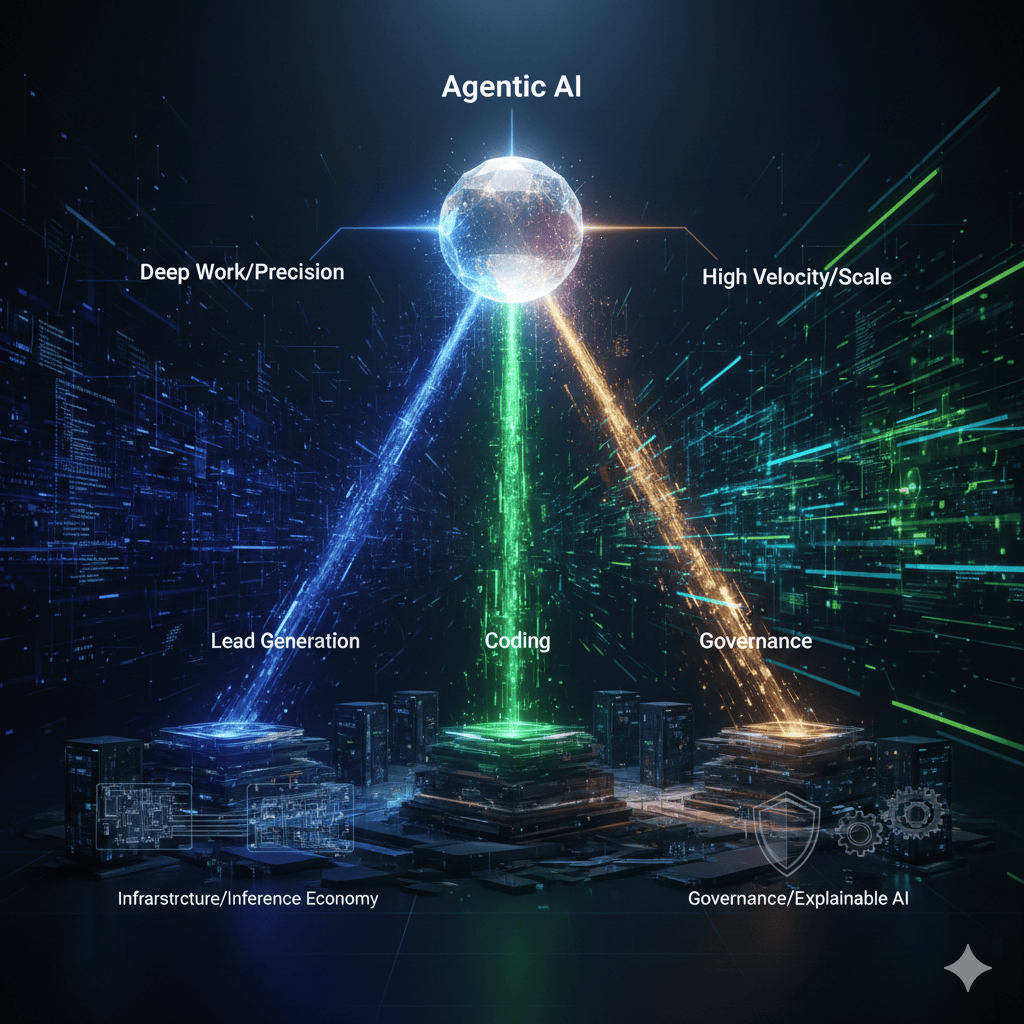
The New Paradigm: From Passive Tools to Autonomous Agents
The state of Artificial Intelligence tools has moved far beyond simple content generation and summarization. The defining characteristic of the 2025 technological landscape is the shift from AI Assistants—which wait for a human command—to Agentic AI—autonomous systems that proactively plan, act, and adapt to execute complex, multi-step tasks independently.1
This is more than a simple product update; it represents the most significant architectural change in business technology since the migration to cloud computing.2 Agentic tools introduce goal-driven intelligence and orchestration layers that allow them to connect and manage APIs, enterprise systems, and plugins without constant human supervision.1 For content creators, this means the most compelling topics are no longer “What can this tool write?” but “What complex workflows can this tool automate?”
The market has bifurcated into two high-value segments:
- Deep Work and Precision: Models like Claude Opus 4, optimized for high accuracy, complex reasoning, and mission-critical tasks (coding, legal analysis).3
- High Velocity and Scale: Models like Gemini 2.5 Pro, optimized for speed, context capacity, and cost efficiency, making “easy work easier” at massive scale.3
This guide provides a comprehensive comparison of the tools defining these categories, alongside a strategic content plan focusing on the durable trends that will sustain readership and relevance through 2026.
Flagship Models: Benchmarking the Best for Deep Work and Scale
The central conflict in the foundation model space is the trade-off between absolute accuracy and operational efficiency. The latest generational leaps from the major players force users to choose a tool based on their primary performance requirement.
Claude Opus 4 vs. Gemini 2.5 Pro: The Strategic Trade-Off
For developers, researchers, and professionals handling mission-critical, complex tasks, performance on rigorous benchmarks dictates tool selection. The comparison between the latest large language models (LLMs) reveals clear specialization:
Claude Opus 4: The Deep Work Champion
Anthropic’s latest specialized LLM is designed for “deep work,” excelling in areas requiring meticulous attention to detail, adherence to safety protocols, and complex analysis.4 Claude Opus 4 is currently recognized as the leading model for rigorous development tasks, exhibiting the highest reported accuracy on the demanding SWE-bench—up to 79.4%.3 This superior performance, particularly for interactive coding and compliance-sensitive sectors, justifies its higher pricing structure ($15.00 per million input tokens).3
Gemini 2.5 Pro: The Efficiency Engine
Google’s Gemini 2.5 Pro is strategically optimized for throughput and data synthesis at scale. While its SWE-bench accuracy is lower (67.2%), it delivers unmatched speed at a blazing fast 142.9 tokens per second.3 Furthermore, its impressive 1M token context window (with planned expansion to 2M tokens) and exceptionally low input price (approximately $1.25 per million tokens) make it the optimal engine for high-volume inference, enterprise data analysis, and integrating AI into consumer-facing applications.3
The LLM market no longer offers a single “best” model, but rather a choice based on the intended application:
| Model | Primary Strength/Focus | SWE-bench Accuracy | Speed (Tokens/sec) | Price (Per M Tokens Input) | Target Task Profile |
| Claude Opus 4 | Deep Work, Coding, Safety | Up to 79.4% | 45–65 | $15.00 | Mission-Critical Coding, Legal Analysis 3 |
| Gemini 2.5 Pro | Efficiency, Multimodality, Context | 67.2% | 142.9 | ~$1.25 | High-Volume Inference, Large Document Analysis 3 |

Specialized Development Tools: The Rise of Antigravity
Beyond generalized LLMs, specialization is key. Google’s Antigravity is a prime example of an “agent-first” software development tool. Launched alongside Gemini 3 Pro, Antigravity uses the model’s advanced reasoning to move past simple chat assistance and autocomplete. The system is designed to run multiple AI agents simultaneously, allowing them to plan, execute, and cross-check their own coding work directly within the code editor and browser environment.7 This positions the tool not as an assistant, but as an active co-worker capable of handling the “heavy lifting” autonomously.7

The Creator Studio: Head-to-Head Comparisons in Generative Media
The generative media space is highly fragmented, with leaders emerging based on specialized output quality and professional utility.
Video Generation: Veo 3’s 4K Edge vs. Kling’s Viral Speed
The video generation market is defined by a race for photorealism, integrated features, and speed, with three major players currently vying for dominance:
- Google Veo 3 (S-Tier): Veo 3 has established itself as the quality leader. Its superior 4K photorealism, integrated audio generation (a crucial feature that removes a complex post-production step), and advanced physics simulation make it the preferred tool for corporate content, agency-grade advertisements, and professional filmmaking, leveraging Google’s vast video libraries for rapid iteration.8
- Kuaishou Kling (High-Speed Motion): Kling excels in creating realistic, high-speed motion and maintaining character consistency across long videos, often including native lip-syncing. This focus on fast, dynamic output positions it as highly effective for viral storytelling on platforms like TikTok and Reels.8
- OpenAI Sora (Narrative Strength): Sora is noted for its ability to interpret complex narrative prompts and deliver stunning visuals and strong narrative flow. However, its utility is limited by a lack of public access and native sound generation.8
Image Creation: Artistry vs. Commercial Assurance
For image generation, the choice often comes down to an artist’s vision versus a professional’s need for compliance and integration.
- Midjourney V7: The Visionary Artist’s Playground: Midjourney remains the tool of choice for artistic visionaries, specializing in stylized, impossibly detailed imagery.10 Recent updates, including a full web application and a “Draft Mode” for generating fast, low-cost images, have improved its workflow flexibility.11
- Adobe Firefly: The Professional’s Choice: For enterprises and professional creators, Adobe Firefly is essential due to its focus on commercial safety and ethical data sourcing. Adobe explicitly assures users that it does not train its models on user creations, addressing critical intellectual property and privacy concerns.12 This distinction positions Firefly as the necessary platform for creators who require control and flexibility within a professional, sustainable, and legally compliant workflow.10
Making Easy Work Easier: Automation and Workflow Optimization
The most direct path to immediate return on investment (ROI) for most businesses lies in using specialized AI to streamline and automate routine, high-frequency tasks.
Specialized Vertical AI for Measurable Efficiency
The trend of highly specialized AI tools designed for a single function is proving far more efficient than relying on general LLMs for niche tasks:
- Julius AI for Data Analysis: This tool is purpose-built exclusively for data analysis and visualization.14 Case studies show its superior efficiency over general LLMs, with one company cutting manual data work from eight to ten hours per week down to mere minutes.14 Its focus on compliance (SOC 2 Type II, GDPR) and privacy makes it a trusted tool for sensitive corporate data.14
- Content Creation Specialists: Tools like Jasper excel as AI writing assistants by incorporating brand voice memory and marketing-specific templates, ensuring consistency across multi-channel campaigns.15 Meanwhile, HubSpot AI’s “content remix” tool automates the repurposing of a single long-form piece into email drafts, social media summaries, and subject lines, drastically improving content velocity.15
The Orchestration Layer: Tools that Glue Workflows Together
The true power of Agentic AI lies in its ability to coordinate tasks across disparate software systems. Orchestration platforms act as the central infrastructure for this capability:
- n8n for Custom Workflow Creation: n8n is recognized as a leader for custom workflow creation, acting as a central integration layer connecting various SaaS tools and databases.16 A real-world example shows a company leveraging an n8n workflow to automate a critical IT operations process, resulting in time savings of over 200 hours of manual work every month.17
- Softr for No-Code Agentic Systems: For businesses with limited technical resources, no-code solutions like Softr enable the building of sophisticated internal applications.18 This includes creating an AI-powered lead qualification system that automatically scores leads, writes tailored follow-up emails, and sends timely Slack notifications for hot prospects—all without requiring complex, expensive third-party connectors.18
- DeepAgent’s Computer Use: Pushing the boundaries of autonomy, DeepAgent’s Computer Use is an AI “operating system” that can actively take control of a desktop, browser, and installed applications to autonomously execute end-to-end tasks like data scraping, debugging code, and automating complex web tasks.19
Quantifying ROI: Case Studies in Lead Qualification
The strongest content for a blog focuses on measurable business outcomes. Sales and marketing automation offer some of the most compelling AI statistics:
- Pipeline Growth: Conversational AI chatbots, which handle up to 80% of routine qualification tasks, have been shown to deliver a staggering 496% increase in pipeline and 454% growth in bookings from chatbot-generated leads.20
- Conversion Accuracy: AI-powered predictive lead scoring improves the accuracy of lead qualification by 40%.21 These systems analyze thousands of data points to identify patterns humans often miss, achieving conversion rates up to 6%, significantly surpassing the B2B average of 3.2%.21
- Productivity Gains: Businesses implementing these AI lead scoring models often experience a 30% increase in sales productivity and a 25% decrease in the sales cycle length.21
The Inference Economy: Why Data Centers Are the New Battleground
The shift in focus within the AI industry is moving from model training (expensive, intermittent) to inference (running the models continuously and at high volume). Deloitte predicts that inference will account for two-thirds of all AI computing power by 2026.22
This operational shift necessitates a massive infrastructure buildout. Current projections include nearly half a trillion dollars dedicated to new data centers and over $200 billion toward specialized AI chips optimized for inference.22 US companies reported strong earnings in Q3 2025, buoyed by the robust demand for AI infrastructure, confirming that the buildout is a core, sustainable economic driver.23
The Looming Data Scarcity Crisis (A 2026 Forecast)
A major constraint on future AI advancement is the availability of high-quality training data. Researchers predict that the public, human-generated data used to train large AI models may effectively run out by 2026, largely due to AI-generated content comprising an estimated 50% of the internet’s material.24
This looming data drought compels the AI community to prioritize synthetic data generation and the cultivation of novel data sources, such as simulations and input from IoT devices, to diversify training sets.24 The strategies used to sustain data flow will dictate the capabilities and eventual success of next-generation models.
From Black Box to Blueprint: The Mandate for Agentic Governance and XAI
As autonomous AI agents become capable of complex, multi-step execution across sensitive enterprise systems, the difficulty of auditing and understanding their decisions skyrockets.1 This Agentic paradigm severely exacerbates the traditional “black box” problem.
Regulatory frameworks are responding by moving toward risk-based models, such as those inspired by the EU AI Act, which categorize AI agents into tiers (unacceptable, high, moderate, and minimal risk) with proportionate oversight mechanisms.25 To comply, organizations must adopt technical governance frameworks, including:
- Explainable AI (XAI): Systems that can explain their decisions in human-understandable terms.26
- Audit Trails: Mechanisms to record the AI agent’s decision process, enabling after-the-fact review and analysis.26
- Continuous Monitoring: Tools to track agent performance and detect unexpected behaviors after deployment.26
Conclusion: Specialization Drives the Next Wave
The AI landscape of 2025 is defined by specialization. Generalized tools may capture initial attention, but sustained success, both for the tools themselves and for the content written about them, lies in quantifiable capability and tangible ROI.
The winning strategy for users is to move beyond the notion of a single “best” model and adopt a tailored toolkit: utilizing high-accuracy models like Claude Opus 4 for sensitive tasks, leveraging the efficiency of Gemini 2.5 Pro for scale, and adopting specialized agents like Julius AI or n8n to automate specific, high-value business functions. For the AI blogger, focusing on the durable, high-impact topics of the Inference Economy, Data Scarcity, and Explainable AI will ensure long-term authority in a field that continues to evolve at a breakneck pace.